

Plant Foraging Guide- Beginner Friendly

A Practical Introduction to Safe, Common, and Useful Edible Plants
Introduction
Foraging is one of humanity's oldest skills. Long before grocery stores existed, people relied on wild plants for food, medicine, and daily survival. Even today, Manitoba's roadsides, forests, riverbanks, abandoned lots, and fields are filled with nutritious edible plants that most people walk past without noticing.
This guide is designed for beginners. Rather than trying to identify hundreds of species, it focuses on a relatively small number of common, abundant, and worthwhile plants that are easy to recognize and useful to know.
Whenever learning a new plant:
Never eat a plant unless you are completely confident in its identification.
Learn multiple identifying characteristics—not just one.
Be aware of potential look-alikes.
Harvest responsibly, leaving enough for wildlife and future growth.
Avoid harvesting from roadsides with heavy traffic, industrial sites, sprayed areas, contaminated soils, or private property without permission.
Master these few species, and you'll discover edible plants almost everywhere you go.
Basic Plant Identification
Before identifying individual plants, it's helpful to understand a few botanical terms you'll encounter in field guides.
For most of the plants shown in here this is not needed, but it's good to learn the main identifying characteristics just like mushrooms.
Leaf Arrangement
Alternate – One leaf per node, alternating up the stem.
Opposite – Two leaves directly across from each other.
Whorled – Three or more leaves growing from the same point.
Leaf Types
Simple Leaf – One undivided leaf blade.
Compound Leaf – Multiple leaflets attached to a single stalk.
Leaf Margins
Smooth (entire)
Toothed (serrated)
Lobed
Wavy
Plant Growth Forms
Basal rosette
Upright stem
Climbing vine
Creeping groundcover
Root Types
Taproot
Fibrous roots
Rhizome
Tuber
Bulb
Flower Types
Composite flowers (daisy family)
Umbels
Spikes
Catkins
Flower clusters
Below are some of the common edible weeds/plants in Manitoba- Do not use this as your only resource do identify but as a list of common ones to learn and explore more on your own- Do your own additional research Make sure to read the DANGER DANGER DANGER Section at the very bottom too Plant Profiles (Alphabetical)
Amaranth (Amaranthus spp.)

Edible Parts
Young leaves
Young stems
Seeds
Harvest
Spring: leaves and stems
Summer: leaves
Fall: seeds
Preparation
Young stems cook much like asparagus. As stems mature they become tough and woody. Leaves can be eaten raw or cooked. Seeds can be toasted or ground into flour.
Habitat
Gardens, disturbed soil, fields, roadsides.
Asparagus (Asparagus officinalis)

Edible Parts
Young shoots
Harvest
Early spring.
Preparation
Cook or eat fresh.
Habitat
Roadsides, old farmsteads, fence lines.
Burdock (Arctium minus)

Edible Parts
First-year root
Young leaf stalks
Harvest
Fall of the first year or early spring before flowering.
Preparation
Roots are excellent roasted, boiled, or stir-fried.
Habitat
Roadsides, disturbed areas.
Cattail (Typha latifolia)
Edible Parts

Spring shoots ("Cossack asparagus")
Immature flower spikes
Pollen
Rhizomes
Harvest
Different edible parts are available throughout the growing season.
Habitat
Marshes, wetlands, riverbanks.
Curly Dock (Rumex crispus)

Edible Parts
Young leaves
Seeds
Harvest
Young leaves before they become bitter.
Preparation
Cook like spinach.
Dandelion (Taraxacum officinale)
Edible Parts

Leaves
Flowers
Flower buds
Roots
Harvest
Entire season.
Preparation
Leaves raw or cooked. Flowers for fritters or wine. Roots roasted for a coffee substitute.
Field Pennycress (Thlaspi arvense)

Edible Parts
Young leaves
Young seed pods
Harvest
Spring.
Preparation
Peppery greens.
Field Sow-thistle (Sonchus arvensis)

Edible Parts
Young leaves
Tender stems
Flower stalks
Harvest
Spring and early summer.
Preparation
Best cooked to reduce bitterness.
Fireweed (Chamerion angustifolium)

Edible Parts
Young shoots
Young leaves
Flowers
Harvest
Spring and early summer.
Preparation
Shoots can be cooked like asparagus. Leaves and flowers make pleasant teas.
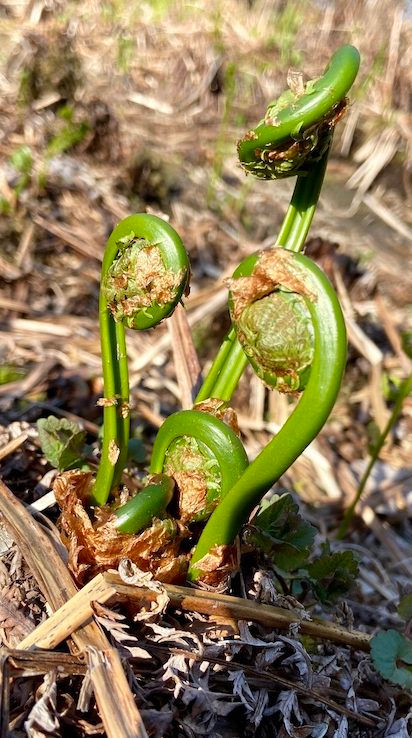
Fiddleheads (primarily Ostrich fern)
Edible Parts
Young tightly coiled fronds
Harvest
Early spring only.
Preparation
Cook thoroughly before eating. Correct identification is important, as not all fern fiddleheads are edible.
Goldenrod (Solidago spp.)

Primarily used for tea.
Young leaves occasionally edible but mainly valued medicinally.
Highbush Cranberry (Viburnum trilobum)

Edible Parts
Berries
Excellent for jelly and sauces after frost or cooking.
Lamb's Quarters / Goosefoot (Chenopodium album)
Difficulty: ★☆☆☆☆

Edible Parts
Young leaves
Young stems
Seeds
Preparation
Often considered superior to spinach.
Plantain (Plantago major)

Edible Parts
Young leaves
Seeds
More commonly valued as a medicinal plant. Helps with burns/stings- Take leaf, chew and apply to wound (spit poultice)
Prickly Lettuce (Lactuca serriola)

Edible Parts
Young leaves
Tender stems
Best harvested before flowering. Does not have thick thorns like the thistle plants but has mild pointy sharp ridges
Rose (Rosa spp.)

Edible Parts - Mainly used in teas/jams
Rose hips
Petals -
Purslane

Common purslane (Portulaca oleracea) is a low-growing, edible succulent with smooth, reddish stems, thick, tear-shaped leaves, and small yellow flowers. It features a central taproot, and when you snap a stem, it releases a clear, mucilaginous sap.
Its most common, toxic look-alike is Spotted Spurge (Euphorbia maculata), which is highly irritating if consumed. [
Key differences to safely identify purslane:
Sap: Spurge oozes a toxic, milky-white latex when broken; purslane has clear sap.
Stems: Purslane stems are smooth and hairless; spurge stems are often hairy. Leaves: Purslane leaves are thick, plump, and succulent. Spurge leaves are flat, thin, and frequently feature a dark purple spot in the center
Thistles- Bull/Canadian The crazy prickly weeds everyone hates- YET ENTIRELY EDIBLE
Bull Thistle: A biennial (2-year lifespan) that spreads only by seed. It features very large, deeply lobed leaves with hairy, grayish-white
undersides and sharp spines on both the leaves and stems. It forms a low, soft rosette in its first year and grows a tall, multi-branched flowering stalk (up to 1.5 - 2.5 m tall) with large, bright purple flowers in its second year. [
Canada Thistle: Spreads via deep, creeping underground rootstocks and seeds. It is shorter (generally under 1 m), has darker green leaves that are smooth on top, slightly hairy underneath, and produces smaller, clustered pinkish-purple flowers Every part of the thistle plant can be eaten, provided you harvest them correctly and strip away the thorns.
The Roots: Roots are the most popular edible part. Dig up first-year rosettes in the late fall or early spring. Bull thistle produces a thicker, meatier taproot, whereas Canada thistle has a creeping, starchy root system. Because they contain inulin, boiling or roasting them breaks down the starches into a sweet, earthy flavor.
The Stems: Young, unflowered stalks can be eaten in the spring. Peel the tough, spiky outer skin thoroughly—much like preparing a stalk of celery or rhubarb—until you reach the tender, juicy inner core. These can be boiled or steamed and taste mildly similar to artichokes or asparagus.
The Leaves: The spiky midrib of the leaves can be peeled and eaten raw or cooked, but they require precision. Canada thistle leaves are particularly tender early in the season, while mature bull thistle leaves are often too fibrous and grass-tasting.
The Flower Buds: Before the flowers fully open, the immature flower buds can be boiled or steamed and eaten just like small artichokes

Stinging Nettle (Urtica dioica)

Edible Parts
Young shoots
Young stems
Young leaves
Mature top leaves
Harvest Best to use gloves as they will sting you, when you cook them the stingers go away.
When small, the entire plant is tender. As it matures, the stem gets much woodier- and then best to harvest only the top section, or just leaves for eating.
Preparation
Cooking, steaming, drying, or blending removes the sting.
Wild Mustard (Brassica spp.)

Edible Parts
Young leaves
Flowers
Seed pods
Seeds
Peppery flavor.
Wild Strawberry (Fragaria virginiana)

Tiny but exceptionally flavorful berries.
Young leaves can also be used for tea.
Yarrow (Achillea millefolium)

Primarily medicinal and used for tea rather than as a food. The leaves are amazing at stopping bleeding. Dried Powdered Leaves: This is considered the best for storage and application. Once the dried leaves are stripped of tough stems and blended into a fine powder, it works as an excellent, highly concentrated styptic powder. It absorbs moisture from the wound and packs tightly to stop bleeding quickly. Fresh Leaves: Ideal for immediate, on-the-spot use and If you don't have dried powdered leaves available- You can chew the leaves or crush them between rocks to create a paste (a "spit poultice") and apply it directly to a scrape or cut
Common Wild Fruits
Saskatoon berry
Wild raspberry
Wild strawberry
Highbush cranberry
Chokecherry
Pin cherry
Wild grape
Rose hips
Buffaloberry (where present)
Lowbush blueberry (in suitable habitats)
Common Wild Nuts
Beaked hazelnut
Bur oak (acorns, after proper leaching)
Black walnut (localized)
Butternut (localized and declining)
American basswood (young leaves are more useful than the small nutlets)
Looking Ahead
Once you're comfortable identifying these species, you'll have a solid foundation for foraging in Manitoba. From there, you can expand into tree foods such as spruce tips, pine needles, birch sap, maple sap, cambium, as well as more advanced edible plants and mushrooms.
DANGER DANGER DANGER
Quick safety takeaway
Don't eat anything you haven't confirmed the ID- check the plants for look alikes- most of the ones listed here are quite easy but better safe than sorry-
Additionally some plants will cause moderate-severe damage simply by touching them so BE CAREFUL!
Giant hogweed → sap + sunlight can cause severe skin burns and blistering. Usually very large (2–5 m / 7–16+ ft tall).
Wild parsnip → sap + sunlight can also cause burns. Usually much smaller (0.5–1.5 m / 1.5–5 ft).
Poison hemlock → highly poisonous if eaten; touching it is not usually the main danger.
Water hemlock → extremely poisonous if eaten; among the most dangerous plants in North America.
For beginners: never eat any wild carrot-family plant unless you can identify it with complete confidence.
Why they get confused
Many Apiaceae plants share umbrella-shaped flower clusters (umbels), hollow stems, and finely divided leaves. From a distance, white-flowered species can look surprisingly similar.
Giant hogweed vs. wild parsnip
Giant hogweed | Wild parsnip |
Huge plant (often taller than a person) | Usually waist- to chest-high |
Large white flower heads (often 30–80 cm across) | Smaller yellow flower heads |
Massive, deeply lobed leaves | Compound leaves with broader leaflets |
Purple blotches/bristles on thick stem | Grooved green stem, usually much thinner |
Phototoxic sap (burns in sunlight) | Phototoxic sap (burns in sunlight) |
Important: giant hogweed is not simply a large wild parsnip. They are different species, though both can cause serious skin reactions after sap exposure and sunlight.
The truly dangerous edible look-alike issue
The classic beginner mistake is not usually hogweed vs. parsnip. It's wild carrot (Queen Anne's lace) vs. poison hemlock or water hemlock.
Memorize these red flags
Purple-blotched smooth stems + white flowers = do not eat. Think poison hemlock until proven otherwise.
Wet ditch, marsh, or stream edge + carrot-like plant = do not eat. Water hemlock favors wet habitats.
Any uncertainty = leave it alone. There are plenty of safer beginner plants to harvest.
A practical field rule
White umbrella flowers? Hands off for food. Photograph it, note the habitat, stem, leaves, and height, then identify it later. Yellow umbrella flowers? Still don't eat it unless you know it confidently. Wild parsnip can burn your skin, and other Apiaceae species can be toxic.
Beginner Warning — Carrot Family (Apiaceae)
Many species have umbrella-shaped flower clusters and can be difficult to distinguish. Some cause severe skin burns (giant hogweed, wild parsnip), while others are highly poisonous if eaten (poison hemlock, water hemlock). Do not harvest any carrot-family plant for food unless you can identify it with complete confidence using multiple features (flowers, leaves, stem, habitat, odor, and season).
One useful Manitoba-specific clue: wild parsnip has yellow flowers, while giant hogweed has white flowers and is dramatically larger. That alone won't identify every plant, but it quickly separates the two species people most often compare.
Respect the Plants
Foraging is one of the safest and most rewarding outdoor skills you can learn—but only when paired with careful observation and respect.
Many edible plants are easy to identify and have few dangerous look-alikes. Others require much more experience. Unlike grocery store vegetables, wild plants have evolved with chemical defenses, and some can cause illness, severe skin injury, or even death if handled or eaten incorrectly.
The goal of this guide is not to encourage taking risks. It is to help you build confidence by learning a small number of common, well-known species thoroughly before expanding your knowledge.
Whenever you encounter a plant you do not recognize, admire it, photograph it, study it—but do not eat it.
Remember:
Identify plants using multiple characteristics, never just one.
Learn the habitat, season, leaves, stems, flowers, fruits, and growth pattern.
Some plants are edible only at certain stages of growth.
Some edible plants require cooking or other preparation before they are safe to eat.
When in doubt, leave it out.
Knowledge grows one plant at a time.
Plants Requiring Extra Caution
These are plants that every beginner should learn to recognize—not because you'll eat them, but because you'll want to avoid them or handle them carefully.
Poison ivy
Why learn it?
The oils in poison ivy can cause an intensely itchy rash, blisters, and skin irritation after contact.
Key Features
Usually three leaflets ("Leaves of three, let it be" is a helpful reminder, though not a foolproof identification method.)
Leaf shape and color vary with the season.
Can grow as a low shrub in Manitoba rather than the climbing vine often seen farther south.
Safety
Avoid touching any part of the plant. The oil (urushiol) can remain active on clothing, boots, tools, and pet fur, so wash exposed items if contact occurs.
Wild parsnip
Why learn it?
The sap contains chemicals that can react with sunlight and cause painful burns and blistering (phytophotodermatitis).
Key Features
Yellow umbrella-shaped flower clusters
Deeply grooved stem
Compound leaves with broad, toothed leaflets
Safety
Avoid getting sap on your skin. If contact occurs, wash the area promptly and keep it out of direct sunlight for at least a couple of days.
Giant hogweed
Why learn it?
One of the most hazardous plants to touch. Its sap can cause severe burns, large blisters, and long-lasting sensitivity to sunlight.
Key Features
Massive size, often much taller than a person
Huge white umbrella-shaped flower clusters
Very large, deeply lobed leaves
Thick stem with purple blotches and coarse bristles
Safety
Do not touch the plant. If sap contacts your skin, wash it immediately and protect the area from sunlight. If sap gets into the eyes, seek urgent medical care.


Comments